CONFERENCE ANNOUNCEMENT AND CALL FOR PAPERS
The 33rd annual workshop of the European Research Network on Transitions in Youth (TIY) will take place in Mannheim, Germany, from 9 to 11 September 2026. The theme of this year’s workshop is:
Risks, Resilience and Opportunities: Youth Transitions in a Changing World
Recent global developments—including the war in Europe, unprecedented waves of migration, de-globalisation, digitalisation, AI-driven transformations, climate change, and political backlashes—have created new risks and fragilities, heightened social fragmentation, and increased inequalities, including growing polarisation between younger and older generations. These changes have substantially reshaped the conditions under which young people pursue vocational training and higher education, enter the labour market, form independent households, establish families, and integrate into key social and economic institutions. At the same time, these profound transformations also generate spaces for resilience and create new opportunities for youth navigating complex transition pathways.
Although research on youth transitions has expanded considerably, the rapid social, technological and political transformations of recent years make it clear that we urgently need innovative and conceptually fresh approaches. New research impulses are essential to understand how evolving structural conditions shape young people’s training and labour market trajectories, demographic behaviour, well-being, and the risks, resilience and opportunities embedded in these transitions.
To contribute to these debates, we are delighted to announce that Jan Stuhler, Professor of Economics at Universidad Carlos III de Madrid, will be the keynote speaker at the workshop.
For the 33rd annual TIY Workshop, the Network Committee invites submissions addressing youth transitions from both single-country and comparative perspectives.
We especially welcome contributions which focus on:
-
The mechanisms through which individual and institutional characteristics generate risks, foster resilience, or create opportunities across youth transitions;
-
The role of economic, structural, and political transformations (e.g., de-globalisation, AI-driven transformations, digitalisation, robotisation) in shaping youth transition patterns and their long-term risk profiles, resilience pathways, and life-course opportunities;
-
The effectiveness of youth policies and institutions in reducing transition risks and inequalities, strengthening resilience, and enhancing labour market outcomes and overall well-being;
-
The challenges and resilience strategies adopted by different social groups, such as those defined by social class, gender, minority background or refugee status;
-
The short- and long-term consequences of youth transitions on employment, demographic behaviour, health, living conditions, well-being, and overall inequality—highlighting where risks accumulate, where resilience emerges, and where opportunities arise.
The Network Committee does not regard these suggested themes as a complete, let alone exclusive list. Theoretically driven empirical research on other aspects of youth transitions that is based on high-quality (longitudinal) data, experimental and intervention studies is also welcome. The committee also encourages researchers to submit papers carrying out meta-analysis.
Anyone who wishes to present a paper or a poster at the workshop should submit an abstract of about 500 words by 19 March 2026 via the conference website. In keeping with our usual procedures, abstracts will be assessed for selection by the members of the Network Committee on the basis of their quality and relevance to the theme of the workshop. Authors will be notified of the decision regarding their paper by 30 April 2026 at the latest.
The conference fee is set at €230 and includes lunches and social events (including conference dinner). A list of hotels in the proximity to the venue will be provided. Since only a limited number of places will be available, anyone who wishes to attend the conference without presenting a paper should inform the conference organisers about this as soon as possible. To ensure the smooth running of the workshop, participants are requested to register until 25 May 2026 and pay the conference fee by 15 June 2026.
To make papers available to workshop participants in advance, final (electronic) versions should be submitted at the very latest by 30 August 2026.
Local organizers:
Irena Kogan, Tamara Gutfleisch, Markus Weißmann
E-Mail: tiy2026@uni-mannheim.de
Abstract submission
Abstract submission is now closed.
Authors will be notified of the decision regarding their paper by 30 April 2026 at the latest.
Programme
Wednesday, September 9, 2026
08.30-09.00 REGISTRATION
09.00-09.15 WELCOME
09.15-10.45 SESSION 1: Uncertainty and Resilience
Chair: Irena Kogan
Vanessa Wittemann (Sciences Po, Paris):
Leaving School in a Crisis: Disrupted Transitions in Germany?
Cristina Iannelli (University of Edinburgh):
Thriving against the odds: An analysis of enabling factors for cognitive development
Ona Valls Casas (Pompeu Fabra University):
Unequal paths: educational vulnerability and post-compulsory educational trajectories in Catalonia
10.45-11.15 Coffee break
11.15-12.45 SESSION 2: Health and Well-being
Chair: Luis Ortiz Gervasi
Emer Smyth (ESRI, Dublin):
Adolescent antisocial behaviour: just a phase or a shadow on the future?
David Reimer (University of Iceland; Aarhus University):
After the Grindavík Evacuation: Adolescent Well-Being in a Repeated Cross-Sectional Follow-Up Study
Repo Juuso (INVEST / University of Turku & University of Iceland):
Rising Diagnoses, Changing Consequences? Adolescent Psychiatric Diagnosis and Educational Transitions in the Nordic Countries
12.45-13.45 Lunch break
13:45-15:45 SESSION 3: Vocational education and training
Chair: Dieter Verhaest
Nicola Ceccarini (IAB; Friedrich-Alexander-University Erlangen-Nuremberg):
Deciding under Constraints. Institutional disadvantage for the disadvantaged in the transition to the German VET
Hans Dietrich (IAB):
Participation and outcomes of apprenticeship training with and without involvement by vocational guidance and counseling of career services
Lina Tobler (University of Cologne):
The long-run effects of monetary (dis‑)incentives on apprenticeship training: Does an apprenticeship minimum wage lead to more or less successful training completions?
Leonie Wicht (IAB; Friedrich-Alexander-University Erlangen-Nuremberg):
Unintended Transitions: Employment Outcomes Following Firm Closures During Vocational Education and Training
15.45-16.15 Coffee break
16.15-17.00 POSTER SESSION
Anna Kiersztyn (University of Warsaw):
Unequal Vulnerabilities: Education, Occupation, and Employment Precarity during the COVID-19 Pandemic in Poland
Alice Broggi (Bamberg Graduate School of Social Sciences, University of Bamberg):
The interaction between gender and social origin: influences on transitions into second-chance education in Germany
Ömer Sahin (Pompeu Fabra University):
Rapid University Expansion and Over-Education: Unequal Consequences in Turkey
Dieter Verhaest (KU Leuven):
The Employment Effects of General and Vocational Education over the Career: Is There Really a Trade-Off?
17.15-18.30 KEYNOTE SPEECH
Jan Stuhler (Universidad Carlos III de Madrid):
Entry Points and Job Ladders: The Role of Firms in Intergenerational Mobility
18.30-19:15 Aperitivo
Thursday, September 10, 2026
Fuchs-Hall (East Wing – Room O 138) in the Mannheim Palace.
09.00-10.30 SESSION 4: The role of digitalisation and new technologies
Chair: Paolo Barbieri
Jorge Céspedes-Rico (Universidad de Castilla-La Mancha):
Digitalisation at the workplace and algorithmic management: opportunities or risks for low qualified and migrant youth?
Markus Lörz (DIPF):
Social inequality in digital competencies among students in Germany: A trend analysis using ICILS data 2013-2023?
Helen Hickmann (University of Cologne; BIBB):
How new technologies and skilled-labor shortage shape educational inequalities at labor market entry
10.30-11.00 Coffee break
11.00-13.00 SESSION 5: Higher education
Chair: Cristina Iannelli
Antje Stefani (Swiss Federal University of Vocational Education and Training):
Does every path lead to the same destination? University and professional education graduates’ access to well-paid occupations in the early career
Francisco Flores Taipe (University of Iceland):
Who Accepts Counselling? Determinants of Take-Up Among First-Generation Students and Implications for Access to Higher Education
Filiz Koneberg (BIBB; University of Cologne):
Labour Market Returns to Education–Occupation Linkages and Match Across Qualification Groups
Elisabeth Hovdhaugen (NIFU):
Borrowing Under Uncertainty: Student Loan Take-Up and Early Persistence in Higher Education
13.00-14.00 Lunch break
14.00-15.30 SESSION 6: The role of gender in youth transitions
Chair: Anna Kiersztyn
Beatrice Caniglia (University of Trento):
Leave and loose? Childbirth, tasks variation and gender economic inequality in Germany
Irene Michelin (University of Trento):
Is Surplus Schooling a Benefit or a Burden for Women? Overeducation and the Gender Wage Gap in Germany and the United Kingdom
Luis Ortiz Gervasi (Universitat Pompeu Fabra):
A Matter of Time? Gender Inequality in Occupational Earnings Potential
15.30-16.00 Coffee break
16.00-17.30 SESSION 7: Residential mobility
Chair: Tamara Gutfleisch
Linda Hoffmann (BIBB):
Spatial mobility and the risk of dropping out of vocational education and training in Germany: Costs, resources, and returns
Kristina Lindemann (University of Edinburgh):
Moving after adverse parental life events: consequences for children’s educational transitions and achievement in Germany
Markus Weißmann (University of Mannheim, MZES):
Signalling belonging or provinciality? The role of regional accents in school-to-work transitions among young people in Germany
19.00 CONFERENCE DINNER
Friday, September 11, 2026
09.00-10.30 SESSION 8: Romantic and peer relations
Chair: Emer Smyth
Maria Köpping (Institute for Advanced Studies; University of Vienna):
Classroom Peer Composition and the Post-Lower Secondary Transition in Austria: Register-Based Evidence from a Tracked System
Valeria Rainero (Goethe University Frankfurt):
Losing Faith or Finding Identity? Classroom Religious Diversity and Religious Participation Across Migrant Background
Jana Kuhlemann (University of Mannheim, MZES):
Labour Market Entry and Partnership Formation among Young Male Refugees: Interlinked Transitions in Germany
10.30-11.00 Coffee break
11.00-12.00 SESSION 9: Aspects of youth transitions
Chair: Hans Dietrich
Ann Berrington (University of Southampton):
Employment stability and social origin: Cumulative advantages in young adults’ homeownership and financial asset accumulation
Stefani Scherer (University of Trento):
Broken Promises of Mobility? Understanding Status Expectations and Political Dissatisfaction through Machine Learning
12.00-12.30 FAREWELL
12.30-13.00 Lunch (take away)
13:45-20:30 SOCIAL EVENT
Registration and fee
Please read the following information and proceed to the registration form by following the link at the bottom.
The conference fee for participants is set at €230 and includes attendance, coffee breaks and lunches, the conference dinner, and the social event. The registration fee does not cover accomodation or travel costs.
REGISTRATION STARTS: MAY 1, 2026
REGISTRATION DEADLINE: MAY 25, 2026
PAYMENT DEADLINE: JUNE 15, 2026
To ensure a smooth running of the workshop, participants are asked to register until May 25, 2026 and pay the conference fee until June 15, 2026. Please note that registration is not final until we receive the conference fee of €230.
To register, please click here.
About TIY
The long-term goal of the Transitions in Youth (TIY) Network is to advance theoretical understanding of transitions in youth, especially of the relationships between education/training and the labour market, through the comparative analysis of regular and longitudinal surveys of transitions.
The TIY Network brings together social scientists interested in the transitions of young people as they progress towards adulthood. The focus is on the transition from education to the labour market, but in the context of other transitions, for example to a new family status or to an independent household.
The principal activity of the Network is to hold annual workshops on specific themes. The number of places at each workshop is limited, but participation is made as “open” as possible by issuing a call for papers.
Apart from these workshops, the Network serves as a forum for researchers. Information on the Network’s activities are distributed through the Network’s email list. For more information see Network’s https://transitionsinyouthnet.org/home/
Network Committee
-
Cristina Iannelli (chair), University of Edinburgh
-
Paolo Barbieri, University of Trento
-
Hans Dietrich, Institute for Employment Research (IAB)
-
Anna Kiersztyn, University of Warsaw
-
Irena Kogan, University of Mannheim
-
Luis Ortiz, Sociodemographic Research Group, Universitat Pompeu Fabra, Barcelona
-
Emer Smyth, Economic and Social Research Institute (ESRI)
-
Dieter Verhaest, Hogeschool-Universiteit Brussel and SHERPPA, Ghent University
-
Katarina Weßling, Maastricht University
Venue
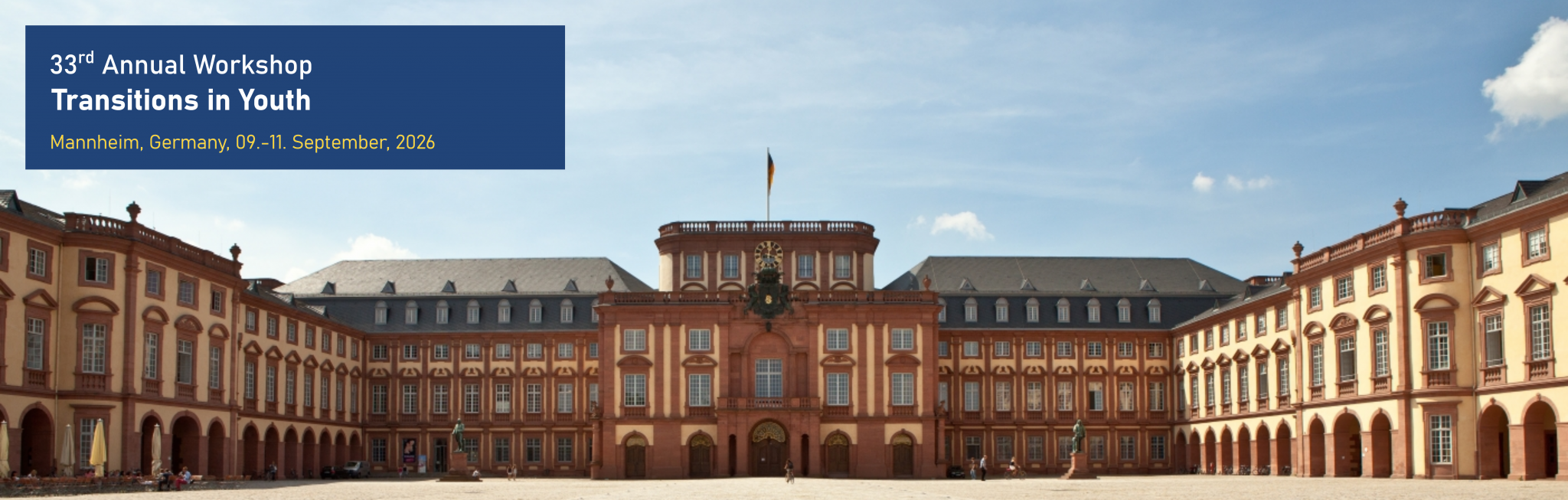
The 33rd Annual Workshop Transitions in Youth will take place in the Fuchs-Hall (East Wing – Room O 138) in the Mannheim Palace. To reach the venue, enter the palace via the university’s main entrance, located in the East Wing of the palace. The address is:
Carl-Theodor-Platz
68161 Mannheim
Germany
Enter the building, walk straight through the foyer and go up the stairs in front of you. After two flights of stairs, you will see the glass facade of the Fuchs-Hall in front of you.

Information on accomodation
The conference fee does not include accomodation. Below, you can find a list providing some options.
Please note that this list represents non-binding information and is not exhaustive. There are no special rates available and attendees are responsible to book and pay for their own accomodation. Of course, you are free to search for and choose any other type accomodation. If you are in need of assistance, do not hesitate to contact the organizing team.
-
Garner Hotel Mannheim City by IHG (L12 15-16)
-
Leonardo Hotel Mannheim City Center (N6, 3)
-
Motel One Mannheim (Paradeplatz 02, 1-10)
-
IntercityHotel Mannheim (Schlossgartenstr. 1 Ecke L13)
-
Holiday Inn – Mannheim City – Hauptbahnhof by IHG (Glücksteinallee 1)
-
Mercure Hotel Mannheim am Rathaus (F7 5-13)
-
Premier Inn Mannheim City Centre (Heinrich-von-Stephan-Straße 18)
Budget hotel options, for instance:
-
B&B HOTEL Mannheim-City (C 7, 9-11)
-
Hotel Wegener (Tattersallstrasse 16)
Travel information
Due to its traffic connections, Mannheim is easy to reach by train, airplane or car. If you want to look up addresses in Mannheim, be aware that the historical city centre is arranged in so-called ‘Quadrate’ (blocks). These blocks serve as street names to which house numbers are added (for instance, the MZES’s address is ‘A5, 6’). This grid system only applies to the historical city centre, while the surrounding parts of Mannheim use common street names.
(1) By train
The Deutsche Bahn (German Railway Company) maintains direct connections to Mannheim from virtually all bigger cities in Germany, such as Berlin, Hamburg, Cologne, Frankfurt, or Munich. Mannheim is well connected by train also to other European cities, such as Brussels, Amsterdam, Berne, Zurich, or Paris. You can check timetables here. The main station is located directly at the edge of the city centre and thus close the workshop venue. From here, several public transport options are available.
(2) By airplane
The easiest connection to Mannheim via plane is to arrive at Frankfurt International Airport. Travelers will find hourly (sometimes half-hourly) train connections from the airport directly to Mannheim main station. The fastest connections take around 30 minutes, ticket prices are around €26. You can check timetables here. Alternatively, flixbus bus company offers direct connections from Terminal 1 to Mannheim’s Central Bus Station. These connections are cheaper (around €10), but take longer (around 60 minutes). You can check timetables here.
NOTE: If you prefer travelling from Frankfurt International Airport to Mannheim with flixbus, we highly recommend booking a seat in advance as there are only a few connections a day with a limited seat availability!
(3) By car
Mannheim can be reached through various access roads, such as Bundesstraßen B36 and B44, motorway A650 and Bundesstraßen B37 or B44 (approaching from the west via Ludwigshafen), motorways A5/A656 (junction Kreuz Heidelberg) or motorways A6/A656 (junction Kreuz Mannheim) and Bundesstraße B37 (approaching from south/south-west), and motorways A6 or A659 and Bundesstraße 38 (junction Viernheimer Kreuz, approaching from the north). Due to many one-way streets in the inner city centre, it is advisable to use a navigation system or to closely study a map, taking into account the direction from which you enter the ‘Quadrate’.
NOTE: Be aware that parking in the inner city centre of Mannheim outside of (underground) parking garages is nearly impossible due to residential parking. However, several parking garages are available in Mannheim. Click here for a list of parking opportunities, including prices and opening hours and a map. Feel free to contact the local organisers if you are in need of any assistance!
Important dates
Abstract submission deadline
19 March 2026
Decision about abstracts
30 April 2026
Registration deadline
25 May 2026
Payment deadline
15 June 2026
Paper submission deadline
30 August 2026
Contact us
Local organizers
Irena Kogan
Tamara Gutfleisch
Markus Weißmann
E-Mail
tiy2026@uni-mannheim.de
Relevant websites
Conference website: https://tiy2026.mzes.uni-mannheim.de
TIY network: https://transitionsinyouthnet.org/home/
Mannheim Centre for European Social Research: https://www.mzes.uni-mannheim.de/en
University of Mannheim: https://www.uni-mannheim.de/en/
Data privacy declaration
For the use of this website, we refer to the privacy policy of the website of the Mannheim Centre for European Social Research (MZES): https://www.mzes.uni-mannheim.de/en/privacy-policy.
In particular, we offer the participants to submit abstracts to and register for the “33rd Annual Workshop Transitions in Youth (TIY)” through our website https://tiy2026.mzes.uni-mannheim.de/. This requires providing personal data and entering it into submission forms. Personal data will be transferred to us and stored. The following personal data will be collected in the process of abstract submission and registration:
-
First and last name of the user
-
Affiliation of the user
-
Address of the user (only registration)
-
Email-address of the user
-
Date of arrival and departure (only registration)
-
Preferences concerning the conference dinner, or dietary requirements (only registration)
At the time of abstract submission or registration the following information will be stored:
-
Date and time of abstract submission or registration
User’ consent to the processing of this data will be obtained during the process of abstract submission or registration.
Legal basis for the processing of the data given user’s consent is Article 6(1)(a) of the EU GDPR.
Users are required to register in order to guarantee that the event “33rd Annual Workshop Transitions in Youth (TIY)” can be adequately prepared and carried out. We do not disclose your personal data to any third party.
The data concerned shall be deleted when they are no longer necessary for the purposes for which they were stored.
At any time, users can cancel their abstract submission or registration or change any personal data stored. Please contact us via tiy2026@uni-mannheim.de for such requests.